

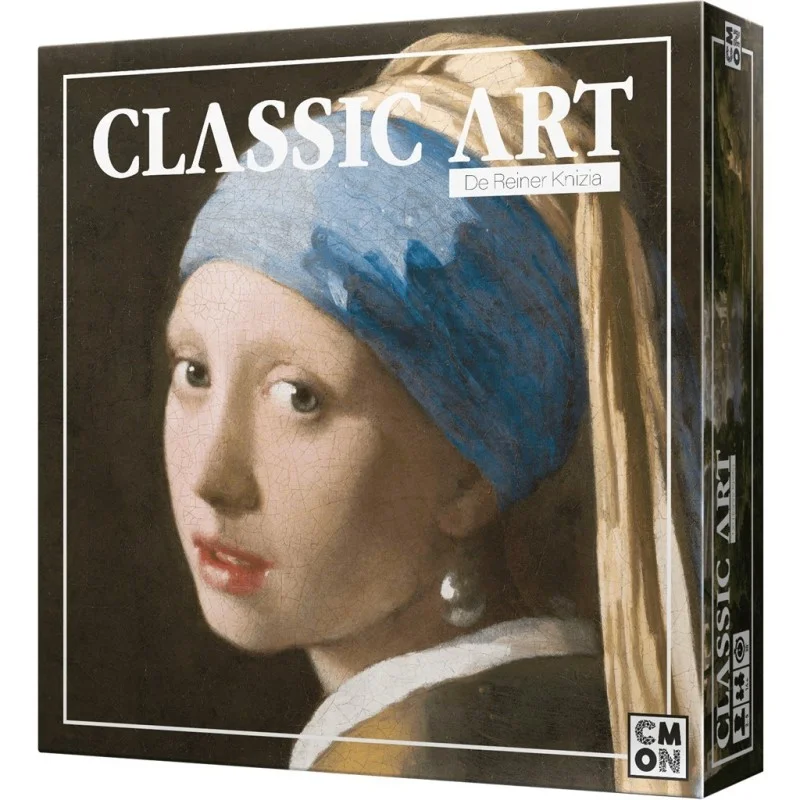
In the first round of the season, players can predict how many artworks will be in an exhibition at the end of the current season by placing 1-2 chips (along with their high-risk chip) in a prediction space . Each exhibition allows betting on whether the artworks will be scarce (bet spaces 1-4) or abundant (bet spaces 5-8). In each subsequent round , the player must place two cards from their hand into the corresponding exhibitions and can then place a prediction . They can only place one “double-chip” prediction in a season, and predicting is optional. When all players have only three cards left in their hand , each player discards one face down and places the other two cards into the exhibitions . Whenever a negative and a positive card appear in an exhibition, they are removed.
At the end of a season , players score points for correct predictions . A large bet is only successful if the number of works is equal to or greater than the bet . The riskier the bet, the higher the payout per chip on that successful bet, with players recording points separately for each exhibition.
At the end of a season , chips from losing bets (except high-risk ones) are removed from the game, while chips from winning bets are returned to the players. If a player has zero or one chip at the end of a season, all their chips are returned.
A player can score a maximum of 10 points in an exhibition . They continue playing seasons until, at the end of a season, each exhibition has at least one player who has scored 5 points . The game ends at that point, and the players tally their scores —but chips in the 0-4 range in an exhibition are worthless. The player with the most points wins .